

The Chore Chart Debate
What Montessori Gets Right About Children and Chores


In many households, the word chores lands with a thud. It brings to mind the familiar chore chart taped to the refrigerator, gold stars negotiated like currency, and the quiet understanding that this is something unpleasant you must get through before you can return to what really matters. Screens. Play. Rest.
Maria Montessori rejected this framing entirely.
What adults often call chores, and try to manage with a chore chart, children experience as something else altogether when it is offered correctly. Montessori did not see children as reluctant helpers who need to be coaxed into responsibility with incentives or consequences. She saw them as purposeful beings, driven by a deep inner need to participate in real life.
This distinction matters more than it seems. When we organize family life around chores and chore charts, we unintentionally undermine a child’s development of agency, competence, and dignity. Montessori classrooms and homes replace the language and structure of chores with something far more powerful.
They offer work.
So, let’s explore the deep pedagogical difference between chores and work in Montessori education, and why Montessori philosophy moves away from the chore chart model altogether.
We will look at Maria Montessori’s original writings, the role of Practical Life, the neurological and emotional impact of meaningful work, and how adults can shift their approach at home without turning everyday life into a battleground.

The Adult Concept of Chores and the Rise of the Chore Chart
In conventional parenting culture, chores are typically defined by three features, and most chore charts reinforce all three.
First, chores are adult-driven. The task exists because the adult wants it done. The chore chart makes expectations visible, but the motivation still belongs to the adult. The child’s participation is secondary.
Second, chores are often disconnected from real consequence. A child cleans their room not because the space genuinely needs tending, but because the chore chart says Tuesday is “room day.” The task exists on paper more than in reality.
Third, chores are transactional. Completion is exchanged for rewards, privileges, or the avoidance of punishment. Stickers, points, allowance, screen time, or approval become the reason the work gets done.
From a developmental perspective, this structure communicates several subtle messages.
You are doing this for me.
This work has no intrinsic value.
Your motivation must come from outside yourself.
Maria Montessori observed that when children are placed in this dynamic, resistance is a logical response. The child is not being invited into community life. They are being conscripted into it, managed through systems like chore charts rather than trusted as capable contributors.
She wrote:
“The child who is forced to act is deprived of the joy of spontaneous activity.”
When chores are framed as obligations imposed from above, whether verbally or through a chore chart, they collide with the child’s natural drive for independence. The result is not responsibility. It is compliance, or rebellion.
Montessori offered a different path.

Montessori’s Definition of Work
In Montessori pedagogy, work is not synonymous with labor, effort, or productivity. It is not defined by how hard something is or how quickly it gets done. Work is any purposeful activity that supports the child’s development and connects them meaningfully to their environment.
Maria Montessori was explicit about this distinction.
“Work is the activity which the individual performs to build himself.”
This is a radical reframing, especially in contrast to chore chart culture. Work is not something done to a child or by a child for an adult. It is something the child does for themselves, as part of their own construction.
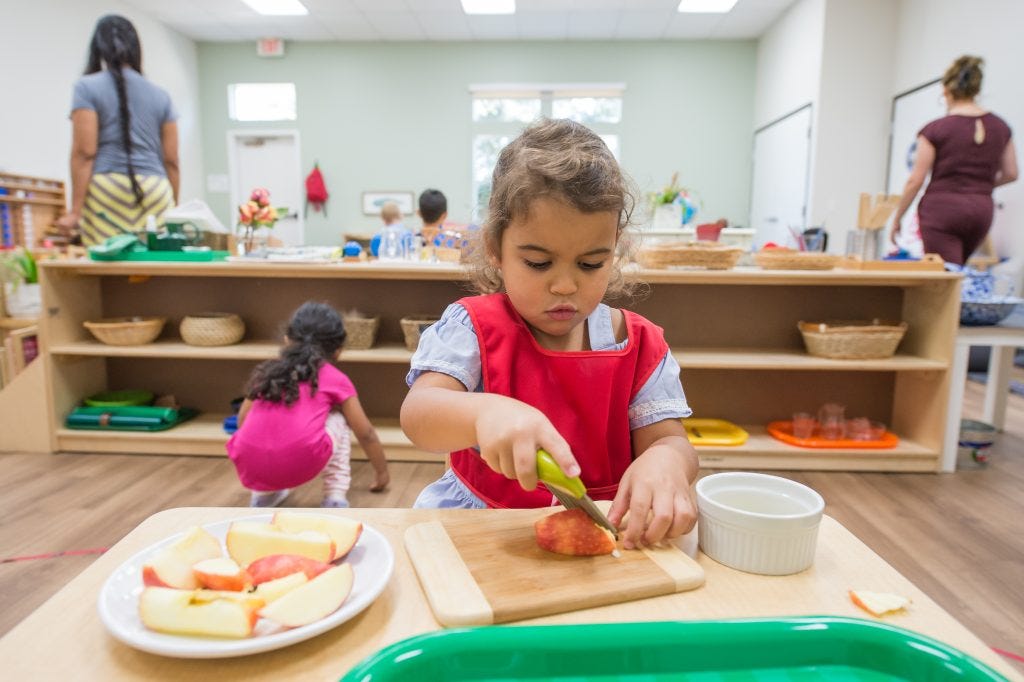
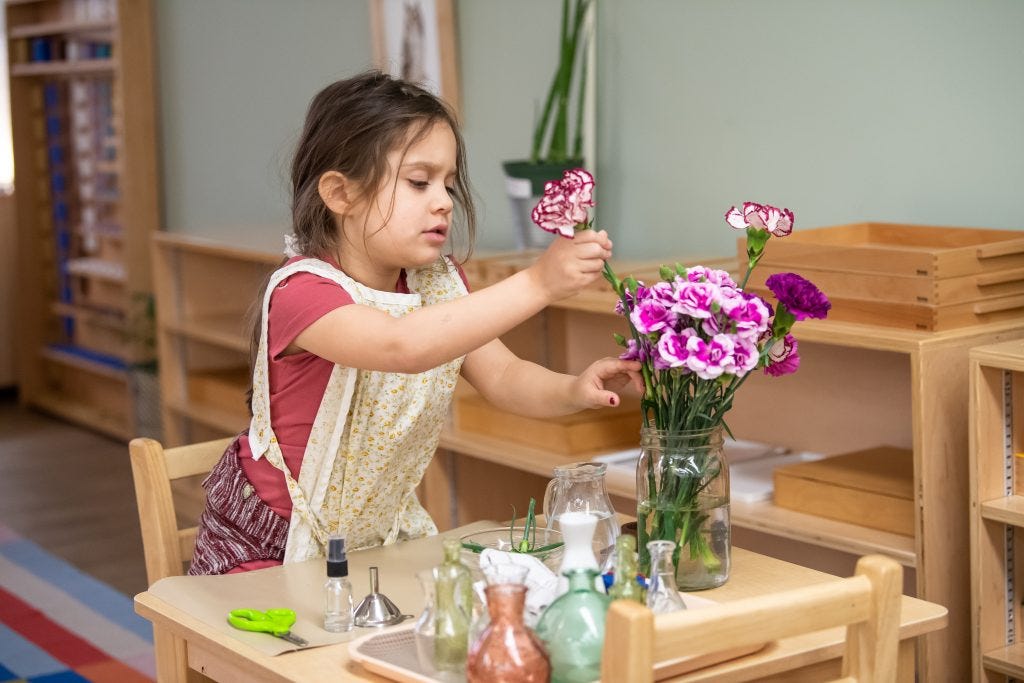
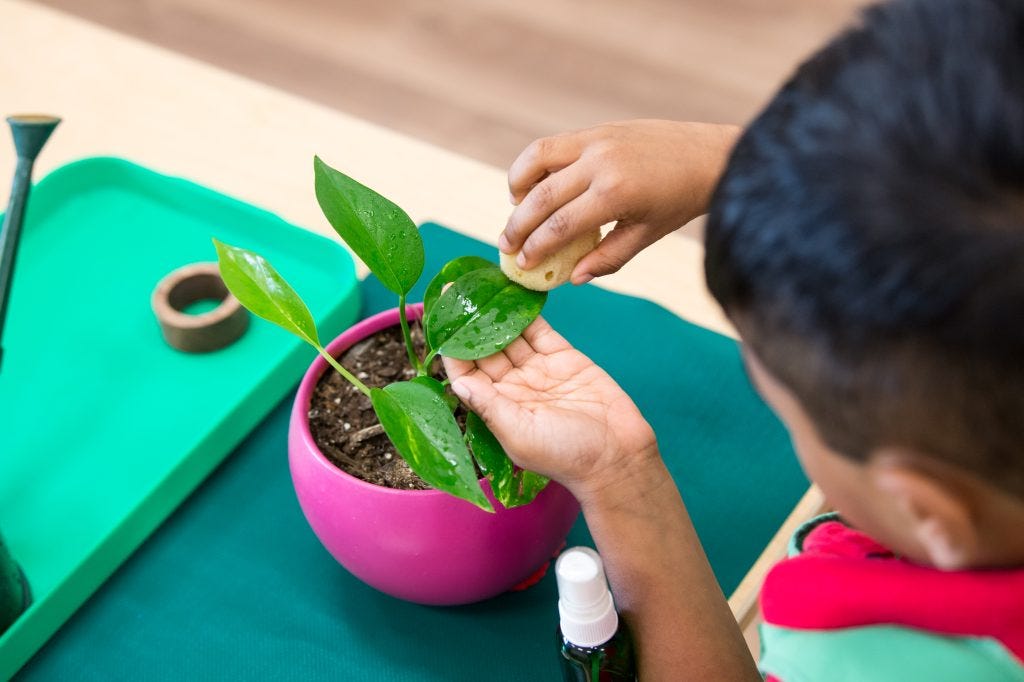
In the Montessori classroom, Practical Life activities form the foundation of this work. Pouring water. Washing a table. Polishing metal. Sweeping. Preparing food. Caring for plants.
To an adult, these may look like chores. They are the very tasks often assigned on a chore chart at home. But to the child, they are acts of construction.
Through this work, the child develops:
Coordination of movement
Concentration
Order
Independence
A sense of belonging
Most importantly, the child experiences themselves as capable.
Montessori observed that when children are given access to real tools and real responsibility, without the pressure of a chore chart or reward system, their behavior changes. They become calmer. More focused. More cooperative.
Not because they are being managed.
But because they are being trusted.

Why Children Are Drawn to Real Work, Not Chore Charts
One of Montessori’s most misunderstood insights is this. Children do not need to be motivated to work. They need to be allowed to work.
Young children are biologically wired to imitate the adults around them. This is not mimicry for entertainment. It is the mechanism through which culture is transmitted and identity is formed.
When a toddler insists on helping load the dishwasher or wipe the counter, they are not trying to be cute or difficult. They are expressing a developmental need. This urge appears long before any child understands a chore chart.
Maria Montessori described this as the child’s drive toward functional independence.
“The child’s progress does not depend only on his age, but also on being free to look around him.”
When adults block access to real activity, replacing it with pretend tasks, toy versions of adult life, or chore chart assignments disconnected from real need, the child’s instinct is frustrated. The result is often what we mislabel as defiance, distraction, or lack of motivation.
But when children are invited into authentic work, something remarkable happens.
They repeat it.
They refine it.
They take pride in it.
Not because someone told them to, not because they earned a sticker, and not because a chore chart says they should, but because it satisfies an internal hunger.

Practical Life. The Heart of Montessori Work
Practical Life is often misunderstood as a warm-up or a soft introduction to “real” learning. In Montessori pedagogy, it is anything but secondary.
It is the foundation.
Practical Life activities are carefully designed to isolate skills, sequence movement, and offer immediate feedback. Each activity has a clear beginning, middle, and end. Each one serves a real purpose in the environment.
When a child washes a table in a Montessori classroom, they are not pretending to clean. The table actually needs washing. The water is real. The soap is real. The result matters.
This is what distinguishes Montessori work from chores listed on a chore chart.
The task is meaningful.
The child chooses it.
The child completes it independently.
Montessori noted that concentration emerges naturally when work meets the child’s developmental needs.
“The essential thing is for the task to arouse such an interest that it engages the child’s whole personality.”
This is not busywork. It is identity formation.

The Psychological Impact of Work vs. Chores
Modern neuroscience supports what Montessori observed over a century ago.
When children engage in purposeful, self-chosen activity, several critical processes are activated.
Executive function develops through planning and sequencing.
Emotional regulation improves through repetition and completion.
Self-efficacy increases as effort leads to visible results.
In contrast, externally imposed chores, especially when managed through a chore chart, rely heavily on compliance. The child’s nervous system remains in a reactive state. Motivation is borrowed, not built.
This difference explains a phenomenon many parents notice but struggle to articulate.
The child who resists chores at home may be calm, focused, and eager to clean in a Montessori environment.
The variable is not the child.
It is the structure.

The Role of the Adult: Guide, Don’t Manage
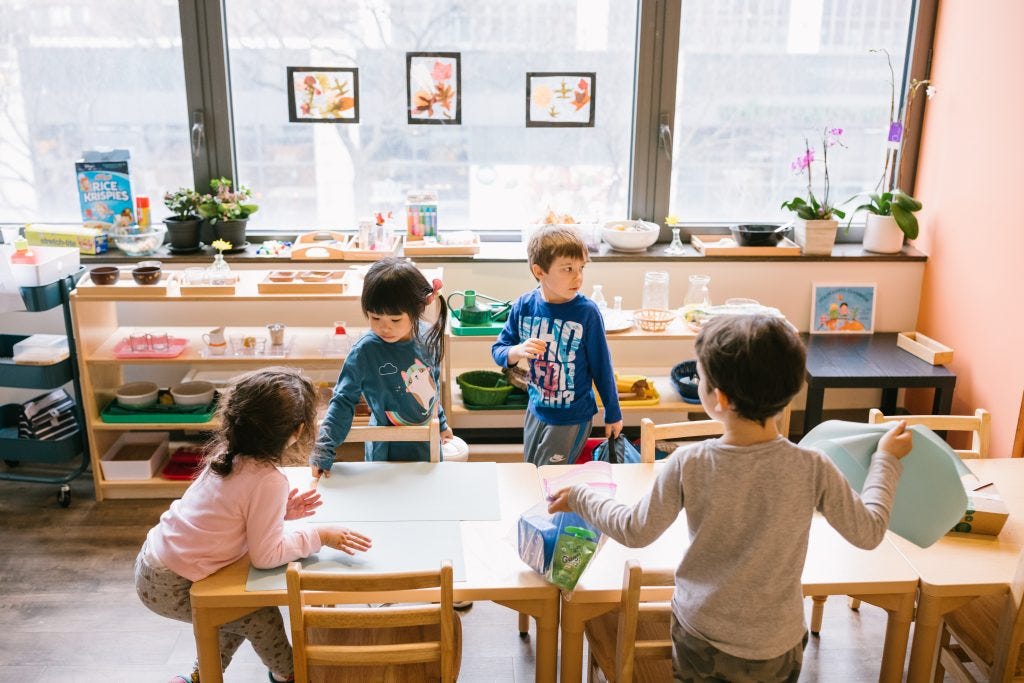
Montessori placed enormous responsibility on the adult. Not to control the child, but to prepare the environment and then step back.
“The greatest sign of success for a teacher is to be able to say, the children are now working as if I did not exist.”
In the context of work versus chores, this means shifting from enforcement, reminders, and chore charts to invitation and trust.
The adult’s role includes:
Slowing down to demonstrate real tasks with care.
Providing child-sized tools that actually function.
Allowing imperfection without correction.
Trusting repetition, even when it seems inefficient.
This requires humility.
It means accepting that the child’s work may not meet adult standards. That the floor may still be streaky. That the laundry may be folded unevenly.
Montessori warned against prioritizing adult convenience over child development.
“Any unnecessary help is an obstacle to development.”
Language Matters. Why Montessori Moves Away From the Chore Chart
Words shape perception. When we label meaningful work as chores, and organize it through a chore chart, we frame it as undesirable by default.
Montessori environments use different language.
Work.
Care of self.
Care of the environment.
Contribution.
These terms reflect respect. They acknowledge that the child is not doing something beneath them. They are participating in shared life.
At home, this shift can be subtle but powerful.
Instead of “You need to do your chores,” or pointing to a chore chart, try:
“This is how we take care of our home.”
“Would you like to help prepare lunch?”
“I see the plants need water.”
The invitation matters. So does the assumption of capability.
When Children Are Trusted With Real Work
Maria Montessori observed a profound transformation when children were given real responsibility. She called this process normalization. Not conformity, but the emergence of the child’s true nature.
When children are trusted with meaningful work, they consistently display joy in effort, deep concentration, self-discipline, and consideration for others. These traits do not come from rewards, punishments, or chore charts. They arise from sustained engagement with reality.
“Discipline must come through liberty.”
This liberty is not chaos. It is freedom within structure, where the structure honors the child’s developmental needs rather than adult convenience or expectations. When work is real, chosen, and purposeful, children regulate themselves from the inside out.
Parents often ask how to bring this philosophy into the home. The answer is not to recreate a Montessori classroom or build a better chore chart. It is to reframe daily life.
Start with the real work that already exists. Food preparation. Cleaning shared spaces. Laundry. Care of pets. Outdoor work.
Ask three simple questions. Is this task real. Can the child do it independently with preparation. Does it contribute meaningfully to our family life.
If the answer is yes, it is work.
Offer the task slowly. Demonstrate with care. Step back. Resist the urge to correct. The goal is not efficiency. The goal is construction of the self.
Why This Matters for the Child, and for the World
The difference between chores and work does not disappear as children grow. Children who experience work as meaningful develop a fundamentally different relationship with effort. They do not ask, “What do I get if I do this?” They ask, “What needs to be done?”
This orientation supports intrinsic motivation, resilience in the face of difficulty, and a sense of purpose beyond the self.
Maria Montessori believed this was essential not only for individual development, but for society itself.
“The child is both a hope and a promise for mankind.”
When we reduce children’s participation to chore charts and incentives, we miss this promise. When we invite them into real work, we honor it.
Montessori did not design an educational method. She revealed a truth about human development.
Children want to belong.
They want to contribute.
They want to work.
Not because they are told to.
Not because a chore chart says they should.
But because it is how they build themselves.
The question is not how to make children do chores.
The question is whether we are willing to see their work for what it truly is.
A quiet, powerful act of becoming.
 | A guest post by
|
Really appreciated this post. Trying to include the littles into the everyday stuff without feeling like I need it done " right " is challenging. Realizing that developing the intrinsic motivation starts with my reprogramming my own mindset, because I view it as chores and just stuff I need to get done so we can function, versus we are taking care of our home...
I always look forward to The Parenting Guide emails! Honestly, they are the only emails I read from beginning to end- and take copious notes. I have three children under three and, as a former public school teacher, I am relearning nearly everything I was taught about children. I am so excited to incorporate even more meaningful work into our home! Thank you for this article!